"I had always assumed that faith was based on purely emotional and
irrational arguments and was astounded to discover that one could build
a very strong case for the plausibility of God," he noted on CNN.
"My earlier atheist's assertion that 'I know there is no God' emerged as
the least defensible."
A geneticist, Collins was appointed director of the $3 billion
international Genome Project in 1993, which completed sequencing the 3.3
billion pairs of nucleotides by 2004. The resulting gene map offers hope
to cure genetic disorders.
It also gave Collins a spectacular
view into the magnificence, order, and finely-tune perfection of the DNA
molecule, God's software for every living thing. Directorship of the
Genome Project was touted as the most prestigious job in science at the
time.
"At the most fundamental level, it's a miracle that there's
a universe at all," he told National Geographic. It's a miracle that
allows the possibility of complexity and laws that follow precise
mathematical formulas. Contemplating this, an open-minded observer is
almost forced to conclude that there must be a "must" behind all this.
To me, that qualifies as a miracle, a profound truth that lies outside
of scientific explanation."
"Science and faith can actually be mutually enriching and complementary
once their proper domains are understood and respected," he says.
"There are some really important questions that science cannot really
answer, such as, why is there something instead of nothing? Why are we
here?"
"In those domains, I have found that faith provides a
better path to answers."
Of particular importance to his faith is the
concept of "moral law" the denunciation of oppression, murder,
treachery, falsehood and the injunction of kindness to the aged, the
young, the weak and helpless, to paraphrase C.S. Lewis.
"After 28
years as a believer, the Moral Law stands out for me as the strongest
signpost of God," he writes in his book.
After obtaining a
degree in quantum mechanics, he decided to change paths in life and
pursued medicine. As a resident he watched people suffering terminal
disease without blaming God. To the contrary, faith seemed to give them
strength and, in many cases, improve their symptoms, he said.
"They had terrible diseases from which they were probably not going to
escape, and yet instead of railing at God, they seemed to lean on their
faith as a source of great comfort and reassurance," he said. They
weren't, somehow, perceiving it as the really awful thing that it seemed
to me to be. And that was interesting and puzzling and unsettling."
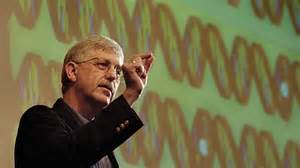
Francis S. Collins, current head of the National Institutes of
Health
P. S. One day while admiring the Cascade Mountains, he
accepted God completely.
P. S.S. If interested in the full article, please go to http://blog.godreports.com/2015/03/nih-director-turned-from-atheism-to-god-as-he-contemplated-science/
With permission from
Francis S.
Collins and
Mark Ellis, God Reports, founder


