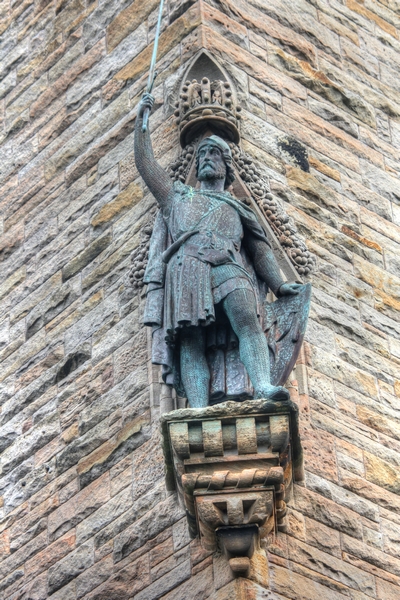
Crime Against the Crown
How many of us have been disillusioned by those who we truly thought
were friends. Have you ever experienced something similar to the
following passage from the book of psalms: "And this, my best friend,
betrayed his best friends; his life betrayed his word. All my life I've
been charmed by his speech, never dreaming he'd turn on me. His words,
which were music to my ears, turned to daggers in my heart." (Ps
55:20-21, MSG)?
Can we count on anyone? Even family?
"Brother will deliver brother over to death, and the father his child,
and children will rise against parents and have them put to death…"
(Matt 10:21, ESV)
Rise up against Parents? Is this even possible?
But then, we have all been disillusioned by others, even those we are
close to. Ask the young girl who is being abused by her own father. Ask
the wife who is served divorce papers. Ask those whose best friends have
hurt them deeply. Is it any wonder we have problems with trust?
Wallace, the hero of Scotland, also experienced betrayal on several
occasions. The worst betrayal happened on August 3rd, 1305, where he was
captured by Sir John Menteith. Sir John, a Scotsman, had once stood
alongside Wallace fighting against the British. He had switched sides,
swearing allegiance to King Edward I, who rewarded him by promoting him
to sheriff and keeper of Dumbarton castle.
Wallace was
immediately taken to England so that no one would notice what had
happened. He was condemned for murder, arson, robbery and treason.
Neither jury, nor defence lawyers were needed.
For his supposed
treason, he was dragged behind horses four miles to Smithfield. For
murder, arson and robbery, he was hanged. However, he was cut down
before he could die, as the king also wanted him to be castrated and
disemboweled. His internal organs were burned, and his head cut off and
put on a spike on the London Bridge. The rest of his body was cut into
four pieces and sent to four different locations.
Some argue that
William Wallace wasn't betrayed, while others think otherwise. What must
Wallace have thought about being sold out to the English by one of his
own clansman?
If anyone can betray us, what is left? Where is
love when trust is but a fleeting notion?
Still, while we ponder
this, we can see a hint of hope rising in the horizon: "For my father
and my mother have forsaken me, but the LORD will take me in." (Ps
27:10, ESV) We have the assurance that our Heavenly Father will always
take us in, accepting us with open arms.
David is the one who
wrote Psalm 27. David also had been betrayed numerous times by his King,
who was also his own father-in-law. He was also betrayed by his son,
Absalom, by his brothers . . . Yet even amidst this adversity, he
discovered the One he could really trust.
Even when he fell into
temptation with a married woman and sent her husband to certain death;
even though God was quite displeased with him, God never abandoned him.
Centuries later, God still bragged about David, saying: "I have found in
David the son of Jesse a man after my heart, who will do all my will."
(Acts 13:22, ESV)
David repented bitterly, as he was the one who
betrayed his God; but God never ever betrayed David. David found out
through all this that God is truly faithful and His love is subliminal:
"Greater love has no one than this: to lay down one's life for one's
friends." (John 15:13, NIV2)
We were the ones who wandered away
from our Father, but He never left us. God did everything necessary for
us to be reconciled with Him. In God we truly can trust, guaranteed as
vouched by the resurrected One!
Should we hate those who betray
us? If we do, we are no better than they. After all, how many times
haven't we betrayed our God, yet He still loves us insatiably.
We
may lose our heads, but we will never lose our souls. Our Father is
trustworthy!
Rob Chaffart


