There is no rest when the wicked roam the land, and in the 9th
century, the Vikings were doing a fantastic job of terrorizing the
Frankish empire. It was, in fact, too easy. They would take their boats
and raid the Frankish coast, then they would sail up the Seine River and
loot anything that was in their path.
It didn't hurt their cause
that after the year 814, the year Charlemagne passed away, his grandsons
fought for his throne. They had no time to worry about the Viking
threat; they had far more important things to quarrel about!
Eventually the Frankish king offered money to the Vikings to leave them
alone. The Viks were satisfied, and they went back to Scandinavia. Only
to return the next year for more money!
The plunder didn't stop.
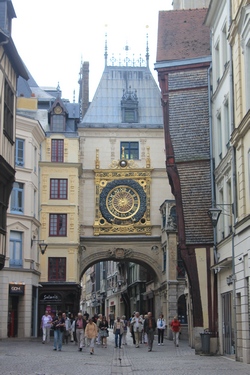
In 841 they looted the famous city of Rouen and burned the monastery of
Jumieges. In 845 they came with even more force: 120 boats and 5,000
men, and they eventually reached Paris. The plundering continued year in
and year out, and nothing seemed to be able to stop those Viks! The
Frankish empire lived in absolute terror. Peace did not exist within its
borders.
Something new happened in 852, however, when the Viks
settled in Oissel land, not too far from Rouen. Their plan was simply to
winter there, but they realize their advantage: From their settlement
they could raid the region whenever they wanted to, Rouen being one of
their favourite places to plunder. Paris was once again looted as well.
King Charles had to do something about them, but he didn't have the
necessary manpower to defeat these stubborn Viks. Instead he signed a
treaty with the Viking leader, Rollon. In return for a peaceful
coexistence, the King offered them territory that corresponds to today's
Haute-Normandie, and in 912, almost a century after the Vikings first
began to plunder France, Rollon was christened, taking the Christian
name "Robert". A name I sure like! Robert became the count of Rouen as
well as the first Duke of Normandy. It is not without reason that
Normandy became one of the most powerful provinces at that time, and
even more importantly, peace and rest finally returned to the Frankish
empire.
More than 1000 years later, D day took place on Normandy
shores, a move that eventually defeated the Nazi menace in France. There
too, rest finally occurred after almost 5 long years of sheer turmoil.
Just like the Frankish empire in the 9th century, after the creation
of the world, rest seemed to be an unknown notion among the inhabitants
of the Earth as well. Despite the fact that the book of Genesis is
filled with examples of people worshipping God, there is no reference
whatsoever, of Sabbath (which means rest in Hebrew).
Only after
the miraculous deliverance of the Israelites from Egypt, do we once
again find the notion of rest: "On the sixth day, they gathered twice as
much-two omers for each person-and the leaders of the community came and
reported this to Moses. He said to them, 'This is what the LORD
commanded: 'Tomorrow is to be a day of Sabbath rest, a holy Sabbath to
the LORD. So bake what you want to bake and boil what you want to boil.
Save whatever is left and keep it until morning.'" (Exodus 16:22-23,
NIV2)
Interestingly the first mention of Sabbath after sin
occurred, was addressed to the freed Israelites, and it was directly
connected with their need of food. Imagine living in a desert. You may
have a tent to keep you out of the sun, but your biggest need would be
water and food, which is something the Israelites began grumbling about
from the beginning of Ex. 16 on. Sorry, but there were no air
conditioners available at that time. Even nowadays, where would you find
a plug in the desert for such a device?
It's clear that God
wanted the people to trust Him as the provider of all their needs, and
their most urgent needs (food and water) were miraculously provided:
manna and quails send from heaven and water from bare rocks. The
Israelites had really nothing to worry about, even in the midst of the
harshest conditions of a sweltering dessert.
Every weekend the
Israelites experienced a miracle. Normally any manna from heaven would
end up "full of maggots" and begin "to smell" if it was kept till the
next day (See Exodus 16:20), but not on their day of rest! "So they
saved it until morning, as Moses commanded, and it did not stink or get
maggots in it." (Exodus 16:24, NIV2)
Unlike us in the Western
world, the Israelites had no need to store provisions. God was their
provider and He always came through. As long as they trusted in God's
provisions, they were provided with all of their needs, even their very
clothes and shoes! "Yet the LORD says, 'During the forty years that I
led you through the wilderness, your clothes did not wear out, nor did
the sandals on your feet.'" (Deuteronomy 29:5, NIV2)
The whole
purpose for this was to give the Israelites an opportunity to get to
know God. "I did this so that you might know that I am the LORD your
God." (Deuteronomy 29:6, NIV2) He is, after all, crazy about us!
I wonder why our society is so stressed, why we never seem to find rest.
Is it possible we have become estranged from God? That we've stopped
trusting Him in all things? He will provide if we trust Him. The
Israelites experienced that first-hand! The problem is that we may have
forgotten what trust really means!
Do you have an oscillating
fan? It sure is hot out there in the middle of the dessert!
Rob
Chaffart
Rest Amidst Stress. Restful Repose, Part 2
Today's Bible Verse:
"I did this so that you might know that I am the LORD your God."
(Deuteronomy 29:6)
Rest Amidst Stress. Restful Repose, Part 2
Announcement:
Would you like to experience real rest? Get to know Jesus. His promise is true: Matt 11:28 "Come to me, all you who are weary and burdened, and I will give you rest."


- This mailing list is a public mailing list - anyone may join or leave, at any time.
-
This mailing list is announce-only.
This newsletter is dedicated to bringing people closer to the Lord through thought-provoking inspirational stories. It is published every Monday, Wednesday, Friday and Sunday.
Privacy Policy:
Our Privacy policy
We will never share, sell, or rent your individual personal information and email address with anyone without your advance permission or unless ordered by a court of law.
How can you stop receiving our newsletters?
Each newsletter sent contains an easy, automated way for you to cease receiving our newsletter. If you wish to do this, simply follow the instructions at the end of any newsletter.
If you have received unwanted, unsolicited email sent via this system or purporting to be sent via this system, please forward a copy of that email with your comments to webmaster@answers2prayer.org for review.